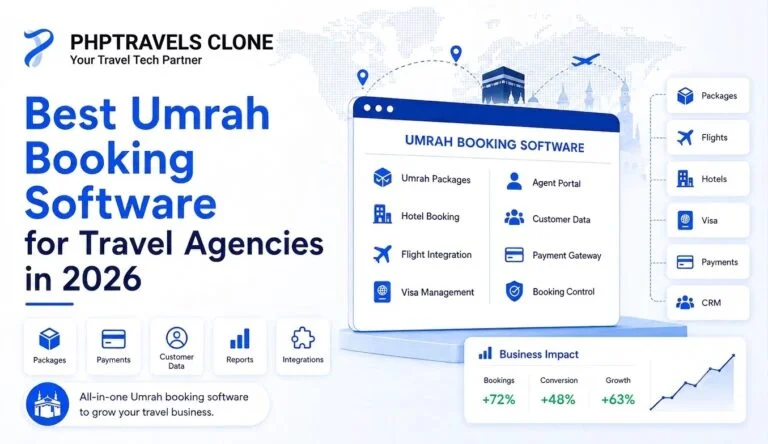
The best Umrah booking software is not necessarily the platform with the longest feature list. It is the system that can complete your agency’s real workflow from the first inquiry to the pilgrim’s departure without forcing staff to maintain separate spreadsheets, messages, payment records, rooming lists, and document folders.
For most travel agencies, the right platform must manage Umrah packages, individual and group bookings, pilgrim records, visa and passport documents, Makkah and Madinah accommodation, transportation, deposits, installments, invoices, customer communication, and operational reports.
Agencies that need greater technical control should also compare source-code access, self-hosting, customization rights, API documentation, data portability, update policies, and long-term ownership costs.
Quick Answer: Which Umrah Booking Software Is Best?
The Umrah booking software for your agency is the platform that can demonstrate your complete booking process using a real package, family, or group departure.
At minimum, shortlist only systems that can handle these five requirements:
- Pilgrim and group booking management
- Visa, passport, and document workflows
- Hotel, room-sharing, and transportation allocation
- Deposits, installments, invoices, and outstanding balances
- Secure data management, integrations, and reliable support
Your final choice should also match the size and operating model of your business.
| Agency Type | Capabilities to Prioritize |
|---|---|
| Small Umrah Agency | Simple package creation, customer records, deposits, invoices, and document tracking. |
| Group Umrah Operator | Group manifests, rooming lists, bus allocation, visa status, and traveler-level payment records. |
| Multi-Branch Agency | Branch controls, staff permissions, centralized reporting, supplier management, and audit logs. |
| B2B and B2C Operator | Agent portal, credit limits, markups, commissions, online booking, and customer checkout. |
| Customization-Led Business | Source-code access, self-hosting, API documentation, data export, and modification rights. |
No system should be selected from a feature page alone. It should complete a realistic workflow in a live demo.
What Is Umrah Booking Software?
Umrah booking software is a specialized travel management platform used by agencies, tour operators, pilgrimage organizers, and Hajj and Umrah businesses.
It connects the main stages of an Umrah booking into one operational record:
Inquiry → Quotation → Package → Pilgrim Registration → Documents → Visa Status → Hotels and Transportation → Payments → Departure → Reporting
Instead of keeping customer conversations in WhatsApp, passport copies in folders, payment balances in spreadsheets, and hotel allocations in separate documents, the software connects these activities to the relevant pilgrim or group booking.
Dedicated Umrah Software vs Generic Travel Software
Generic travel software may manage flights, hotels, tours, and standard customer reservations. Dedicated Umrah software must support the additional workflows involved in pilgrimage travel.
| Requirement | Dedicated Umrah software | Generic travel software |
| Pilgrim records | Structured records for each traveler | Standard customer profiles |
| Visa workflow | Status and documents connected to the booking | Often managed outside the platform |
| Group manifests | Group rosters and traveler-level tracking | May require spreadsheets |
| Room sharing | Double, triple, and quad-sharing allocation | Usually standard room reservations |
| Transportation | Shared buses, transfers, and departure logistics | General transfer booking |
| Installments | Payment status for each pilgrim | May require customization |
| Departure communication | Group instructions and traveler updates | Standard booking notifications |
The correct system should reduce manual handoffs between sales, operations, accounts, and customer support.
1. Can the Software Create Flexible Umrah Packages?
Package creation is the foundation of an Umrah booking platform.
Your team should be able to configure:
- Departure and return dates
- Number of nights
- Makkah and Madinah hotels
- Check-in and check-out dates
- Room type and occupancy
- Double, triple, and quad-sharing options
- Flights and airline details
- Airport and ground transportation
- Meals
- Ziyarat and optional tours
- Adult and child pricing
- Economy, standard, and premium packages
- Individual, family, and group departures
The system should allow authorized staff to update availability, hotel details, pricing, or transportation without rebuilding the complete package.
2. Can It Manage Individual, Family, and Group Bookings?
Group management is one of the main differences between standard booking software and a dedicated Umrah system.
A suitable platform should allow staff to:
- Register multiple pilgrims
- Connect family members to one booking
- Assign travelers to a departure group
- Maintain group rosters and manifests
- Allocate rooms and sharing arrangements
- Assign buses, seats, or transfers
- Track documents for every traveler
- View each pilgrim’s payment status
- Apply an update to the complete group
- Separate group-level and traveler-level information
Do not test only a single-traveler booking. Ask the provider to demonstrate both a family booking and a larger group departure.
3. How Does the System Handle Visas and Documents?
Visa and document information should be connected to the individual pilgrim rather than stored in a general folder.
Your staff may need to manage:
- Passport information
- Passport scans
- Photographs
- Visa submission status
- Approval, rejection, or pending status
- Missing-document reminders
- Passport expiry dates
- Medical or vaccination documents where applicable
- Internal verification notes
- Document access permissions
- Traveler communication history
The dashboard should clearly show which pilgrims are ready, which records are incomplete, and which bookings require staff attention.
Software can organize the workflow, but it does not replace the agency’s responsibility to follow current requirements from relevant authorities and approved service providers.
4. Can It Manage Hotels, Rooms, and Transportation?
Accommodation management involves more than saving a hotel name.
The platform should help manage:
- Hotel allotments and contracted blocks
- Makkah and Madinah stays
- Check-in and check-out schedules
- Room categories
- Double, triple, and quad-sharing
- Male and female rooming arrangements where required
- Available and allocated rooms
- Supplier confirmations
- Hotel vouchers
- Booking changes and reallocation
- Airport transfers
- Shared buses and ground transportation
- Pickup and departure schedules
This becomes especially important when an agency is operating several groups with overlapping dates.
Demo test: Change a hotel or room allocation after a group has already been created. Check whether the update appears correctly in the booking, voucher, rooming list, and customer communication.
5. Does the CRM Connect Inquiries With Bookings?
A travel agency CRM should connect the sales conversation to the confirmed booking.
A practical workflow may look like this:
- A customer submits an inquiry.
- The inquiry is assigned to an agent.
- The agent creates a quotation or recommends a package.
- Follow-up reminders are scheduled.
- The customer confirms the booking.
- Pilgrim details and documents are collected.
- Payments are connected to the same record.
- Operations staff prepare hotels and transportation.
- The customer receives relevant updates.
This prevents inquiries, bookings, documents, and payments from becoming disconnected across different systems.
Check whether the CRM supports lead sources, follow-up tasks, agent performance, quotation history, notes, and role-based access.
6. Can It Manage Deposits, Installments, and Invoices?
Many Umrah customers pay through a deposit followed by one or more installments.
The system should support:
- Initial deposits
- Partial payments
- Installment schedules
- Payment due dates
- Remaining balances
- Individual and group payment status
- Receipts and invoices
- Refund records
- Supplier payments
- Multiple currencies where required
- Tax or fee configuration
- Payment-status reports
- Accounting exports or integrations
During the demo, ask the provider to record a deposit, add a second installment, generate an invoice, process an adjustment, and show the remaining balance.
A generic “payment management included” statement is not enough.
7. Does It Support B2B, B2C, Branches, and Agents?
Your current business model may be simple, but the software should provide a reasonable path for growth.
Growing agencies may require:
- Direct B2C customer bookings
- B2B agent bookings
- Agent credit limits
- Markups and commissions
- Branch-level access
- Centralized customer records
- Staff roles and permissions
- Supplier contracts
- Multi-brand or white-label portals
- Consolidated financial reporting
- Agent and branch performance reports
A small agency should not purchase unnecessary enterprise modules. However, it should understand what will happen when it adds new agents, branches, destinations, or sales channels.
8. Which Integrations and APIs Matter?
Integrations allow the Umrah platform to exchange information with external services.
Depending on your operation, useful integrations may include:
- Hotel suppliers
- Flight suppliers
- Payment gateways
- Email services
- SMS providers
- WhatsApp or communication tools
- Accounting software
- Customer-support systems
- Maps and location services
- Custom supplier databases
- Mobile applications
- Internal reporting tools
Ask whether each integration is already available, requires custom development, or depends on separate supplier approval.
Also verify:
- Setup fee
- Recurring fee
- API limits
- Sandbox availability
- Error handling
- Documentation
- Support responsibility
- Data synchronization frequency
Never assume that an integration shown on a logo page is included in the quoted software package.
9. Cloud-Based, Self-Hosted, or Source-Code Software?
The deployment model affects cost, control, security responsibility, and future customization.
Cloud-based software may suit agencies that want:
- Faster setup
- Provider-managed hosting
- Automatic backups
- Managed software updates
- Remote access
- Less server administration
Self-hosted or source-code software may suit agencies that want:
- Control over the hosting environment
- Greater customization flexibility
- Direct access to the codebase
- Internal development control
- Specific data-location requirements
- Reduced dependence on a single hosted provider
Before choosing, compare:
- Source-code access
- Modification rights
- Hosting responsibility
- Backup and recovery responsibility
- Update and bug-fix policy
- Data export options
- API access
- Documentation
- License restrictions
- Branding and white-label rights
- Developer requirements
- Vendor lock-in risk
“Source code included” does not automatically mean unlimited customization rights. Confirm the license and modification terms in writing.
10. How Can You Evaluate Security and Data Control?
Umrah agencies may process passport details, contact information, invoices, payment records, and other sensitive documents.
Ask the provider to demonstrate:
- Encryption in transit and at rest
- Role-based staff permissions
- Activity and audit logs
- Backup and restoration procedures
- Document access controls
- Former employee access removal
- Password and login protection
- Payment-gateway handling
- Data retention settings
- Data export and deletion
- Security update procedures
- Incident-response process
Do not accept a general statement that the platform is “fully secure.” Ask to see the relevant controls and request written technical documentation where available.
11. How Much Does Umrah Booking Software Cost?
The advertised price is only one part of the total cost.
Initial costs may include:
- Software license
- Setup and installation
- Data migration
- Module configuration
- Design and branding
- Custom development
- Staff training
- API integration
Recurring costs may include:
- Hosting
- Support plans
- Software updates
- Supplier APIs
- Payment-gateway charges
- SMS and email services
- Backup services
- Additional users or branches
Hidden operational costs may include:
- Duplicate data entry
- Manual payment reconciliation
- Missed customer follow-ups
- Booking errors
- Staff training time
- Repeated custom development
- Dependency on one vendor
- Difficult data migration
Compare the three-year cost rather than only the starting price.
Request a written quotation that clearly separates included features, optional services, third-party costs, support, updates, customization rights, and future charges.
12. What Implementation, Training, and Support Are Included?
Useful software can still fail when setup and staff adoption are poorly managed.
Before purchasing, ask about:
- Initial configuration
- Data import
- Package setup
- Supplier configuration
- Payment-gateway setup
- Staff training
- Administrator training
- Documentation
- Support channels
- Response-time targets
- Escalation process
- Bug-fix policy
- Software updates
- Customization support
- Backup responsibility
- Post-launch review
Identify which tasks belong to the vendor and which remain the responsibility of your agency.
A Simple 24-Point Vendor Scoring System
Score each of the 12 criteria as follows:
- 0: Missing or requires an external manual process
- 1: Available with limitations or customization
- 2: Demonstrated successfully in the standard platform
The maximum score is 24.
Do not select a platform based only on the total score. Mark these five categories as mandatory:
- Group management
- Visa and documents
- Hotels and transportation
- Payments and invoices
- Security and data access
A platform that fails a mandatory requirement should not remain on the shortlist, even if its overall score is high.
How Should You Test Umrah Software During a Demo?
Ask the provider to demonstrate this complete workflow:
- Create an Umrah package.
- Add Makkah and Madinah hotels.
- Configure transportation.
- Register a family or group.
- Upload a traveler document.
- Mark one document as missing.
- Update a visa status.
- Allocate rooms.
- Assign transportation.
- Record a deposit.
- Add an installment.
- Generate an invoice.
- Show the outstanding balance.
- Produce a group manifest or rooming list.
- Prepare a customer update.
- Change one part of the confirmed booking.
- Review the activity log.
- Export an operational or payment report.
The provider should use the functioning platform rather than relying entirely on slides or feature descriptions.
Common Mistakes to Avoid
Avoid these software-selection mistakes:
- Choosing only by price
- Buying without a real workflow demonstration
- Assuming every integration is included
- Ignoring group-booking requirements
- Failing to test installments and refunds
- Overlooking source-code license restrictions
- Ignoring data export and migration
- Selecting software staff find difficult to use
- Purchasing unnecessary modules
- Ignoring future branches or agent networks
- Accepting unsupported security claims
- Relying on unverified AI or automation claims
- Failing to define vendor and agency responsibilities
The purpose of the software is to reduce operational complexity, not relocate it to another system.
Where phptravelsclone Fits in Your Comparison
phptravelsclone provides travel booking technology for agencies and operators that need package management, pilgrim registration, group operations, visa and document workflows, hotel and transportation allocation, deposits, installments, customer communication, and broader travel-management functionality.
The platform may be relevant to agencies that want to connect Umrah operations with CRM, hotel booking, supplier integrations, payment processing, B2B or B2C sales, and agency-management workflows.
Businesses that require greater technical control can also evaluate available self-hosting, source-code, customization, and integration options.
Before making a decision, request written confirmation of:
- Included Umrah features
- Source-code and modification rights
- Required modules
- Hosting responsibility
- Integration charges
- Support scope
- Update policy
- Custom-development cost
- Setup and training
- Data migration
- Delivery timeline
Then test the complete Umrah workflow in a live demo.